
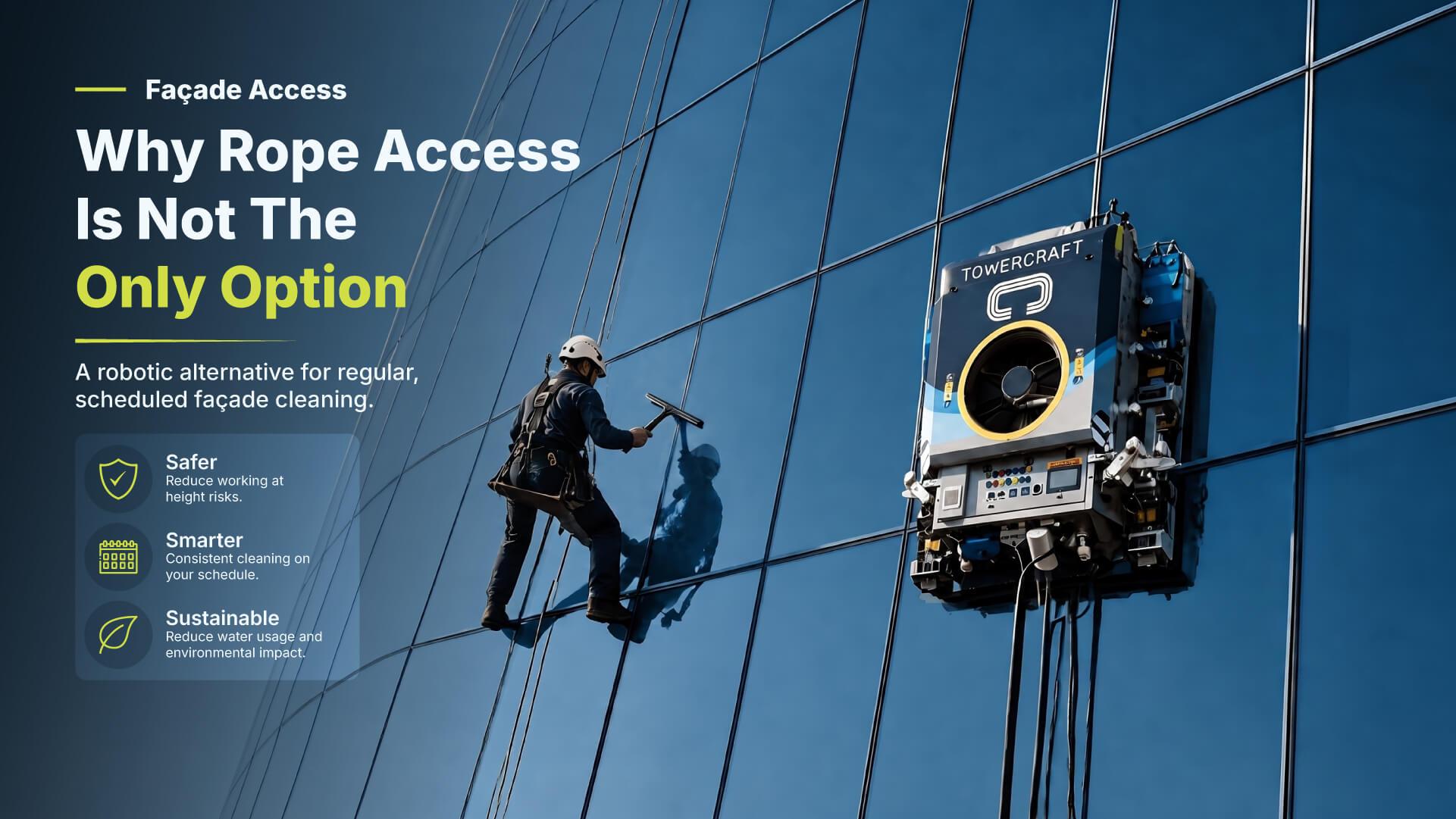
Why Rope Access Is Not the Only Option?
For decades, rope access has been the default method for maintaining the exteriors of tall buildings. Skilled operatives suspended from rooftops, working at height under challenging conditions — this image has become synonymous with façade cleaning, inspection, and maintenance. It is a method that has served the industry well. But as the built environment grows more complex, and as expectations around safety, operational continuity, data quality, and sustainability intensify, it is worth asking a straightforward question: is rope access still the only viable option?
The answer, increasingly, is no.
The Limitations of a Traditional Approach
Rope access remains a legitimate and widely used technique. However, it carries inherent constraints that are becoming more difficult to ignore in the context of modern asset management.
Work-at-height operations involve significant risk — not only to the operatives themselves, but to the organisations responsible for their welfare. Managing that risk requires rigorous planning, trained personnel, favourable weather conditions, and robust compliance with health and safety legislation. Even with all of these in place, the exposure remains real.
Beyond safety, there are operational considerations. Rope access teams require careful coordination, access to roof anchoring systems, and conditions that allow safe deployment. In environments such as busy airports, operational hospital campuses, or large retail centres, scheduling window access around footfall, weather, and regulatory requirements can be logistically complex and costly.
Perhaps most significantly, traditional methods are largely observational. An operative working at height can identify visible defects and carry out cleaning tasks, but the depth of inspection data generated is limited. In an era where building owners and facility managers are increasingly expected to make evidence-based decisions about asset condition, a purely manual approach may not provide the level of insight that modern portfolio management demands.
A Broader Toolkit for Modern Façade Maintenance
Robotic technology does not replace the need for professional expertise — it extends what that expertise can achieve. Platforms designed specifically for façade maintenance operate at height without putting human operatives in elevated positions, and they are capable of carrying out cleaning, surface inspection, and condition monitoring in a consistent, repeatable manner.
This shift matters for several reasons.
Safety Without Compromise
Removing operatives from high-risk positions at height is one of the most direct ways to reduce the likelihood of serious incidents. Robotic systems can access building exteriors in conditions and locations that would present significant challenges for human teams, carrying out tasks systematically and without fatigue-related variability.
For health and safety professionals and facility management companies, this represents a meaningful change in how risk is allocated within a maintenance programme.
Data-Driven Inspection and Reporting
One of the most compelling aspects of robotic façade technology is the quality and consistency of the data it can generate. Equipped with AI-assisted imaging and real-time video transmission, robotic systems can capture detailed surface data across large façade areas — documenting condition, identifying anomalies, and producing structured reports that can inform maintenance planning and budgeting.
This is particularly relevant for building owners and property managers responsible for large or complex assets, where understanding the true condition of the building envelope is essential for both operational and compliance purposes.
Operational Continuity
Because robotic systems do not require the same access constraints as rope teams — roof anchor points, exclusion zones, weather windows — they can often be deployed with less disruption to a building's operations. For environments like shopping centres, airports, or hospital facilities where operational continuity is a priority, this flexibility has practical value.
Rethinking the Default
None of this suggests that rope access should be dismissed. There will always be situations where it remains the appropriate method — whether due to architectural complexity, site-specific constraints, or the nature of the maintenance task itself.
What has changed is the assumption that it is the only option. As robotic technology matures and its capabilities become more established within the façade maintenance sector, building owners, facility managers, and health and safety professionals have a broader set of tools available to them. The question is no longer whether alternatives exist, but how best to integrate them into a maintenance strategy that prioritises safety, data quality, and long-term asset performance.
Looking Ahead
The building maintenance industry is at a point of genuine transition. Organisations with ESG commitments, risk management obligations, and complex asset portfolios are under increasing pressure to demonstrate that their maintenance approaches are not only effective, but responsible.
Robotic façade maintenance technology — with its focus on safe working, intelligent inspection, and structured data outputs — is well positioned to support that shift. As the sector continues to evolve, the integration of robotics alongside traditional methods is likely to become not the exception, but the standard.