
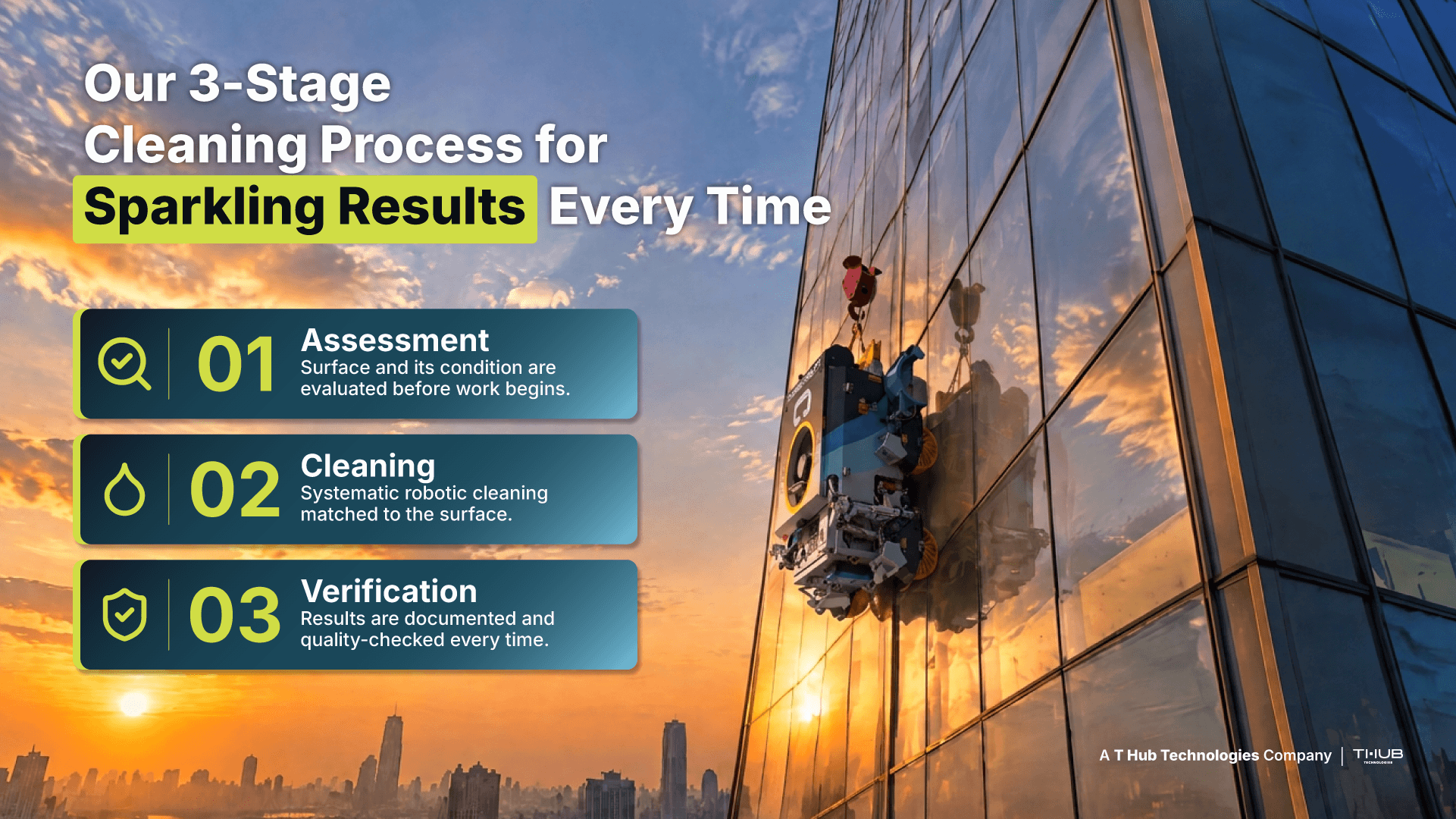
Our 3-Stage Cleaning Process for Sparkling Results Every Time
Maintaining the exterior of a modern high-rise is far more than a cosmetic exercise. Façades protect the building envelope, influence how a property performs and shape how it is perceived. Yet the traditional methods used to clean and inspect them often rely heavily on manual work at height, which can be time-consuming, difficult to standardise and hard to document. Towercraft approaches this differently, using robotic technology to make façade maintenance safer, more consistent and more measurable. One helpful way to understand this is through a structured, three-stage approach.
Rethinking Façade Maintenance for Modern Buildings
For building owners, property managers and facility management teams, façade upkeep sits at the intersection of safety, cost and long-term asset value. When maintenance is treated as a series of disconnected tasks, it becomes harder to plan, harder to measure and harder to justify. A more structured model — moving from assessment to action to record-keeping — brings clarity to a process that has historically been difficult to standardise. This is where robotic systems, automation and AI-assisted analysis can play a supportive role.
Stage One — Inspection and Surface Analysis
Before any cleaning takes place, understanding the condition of the façade is essential. In this first stage, Towercraft's technology draws on AI-assisted imaging and surface analysis to build a clearer picture of the building envelope. Real-time video streaming allows relevant teams to observe conditions as they are captured, rather than relying solely on reports compiled afterwards.
This assessment-led approach helps identify areas that may require attention and supports more informed planning. Rather than treating every surface identically, a data-informed starting point allows maintenance to be directed where it matters most. For facility management professionals and property managers, this can translate into clearer visibility over the state of an asset and a stronger basis for decision-making.
Stage Two — Robotic Cleaning at Height
The second stage focuses on the cleaning process itself. Here, robotic systems and automation carry out work that would traditionally require extensive manual access at height. By reducing reliance on people working in exposed, elevated positions, this approach supports health and safety objectives — an increasingly important consideration for building owners and H&S professionals.
Automation also supports consistency. Robotic systems can follow repeatable patterns across large surface areas, which helps standardise how cleaning is carried out across a façade. For large real estate assets, airports, shopping centres and hospitals — where façades are extensive and access is complex — this kind of consistency can be particularly valuable, helping bring a more uniform standard to buildings that are otherwise difficult to service.
Stage Three — Reporting and Data-Driven Insight
The final stage turns activity into information. Through smart maintenance reporting, the work carried out and the conditions observed can be captured and organised into a clearer record. This supports data-driven maintenance, where decisions are guided by documented insight rather than assumption.
Over time, this kind of reporting can help organisations understand how a façade is performing, plan future work more effectively and demonstrate that appropriate care is being taken. For sustainability and ESG-focused organisations, structured documentation can also support wider reporting and accountability goals, connecting day-to-day maintenance with longer-term objectives.
Bringing Safety, Efficiency and Sustainability Together
Across all three stages, several themes recur: safety, operational efficiency and sustainability. By reducing work at height, the approach helps address one of the most significant risks associated with traditional façade maintenance. By using automation and repeatable processes, it supports operational efficiency across large and complex buildings. And by enabling data-driven decisions, it helps organisations care for their assets in a more considered, resource-aware way.
Seen together, these stages reframe façade maintenance as an ongoing, informed process rather than a one-off task — something that can be planned, measured and improved over time.
A More Considered Approach to Façade Care
Viewed as a connected sequence rather than isolated activities, inspection, cleaning and reporting form a more coherent way to care for modern buildings. Towercraft's role is to bring robotic systems, AI-assisted analysis and smart reporting together in support of safer, more efficient and more sustainable façade maintenance. For the professionals responsible for high-value buildings, this structured, technology-led approach offers a way to think about exterior upkeep not simply as cleaning, but as a measured process built around safety and long-term value.