
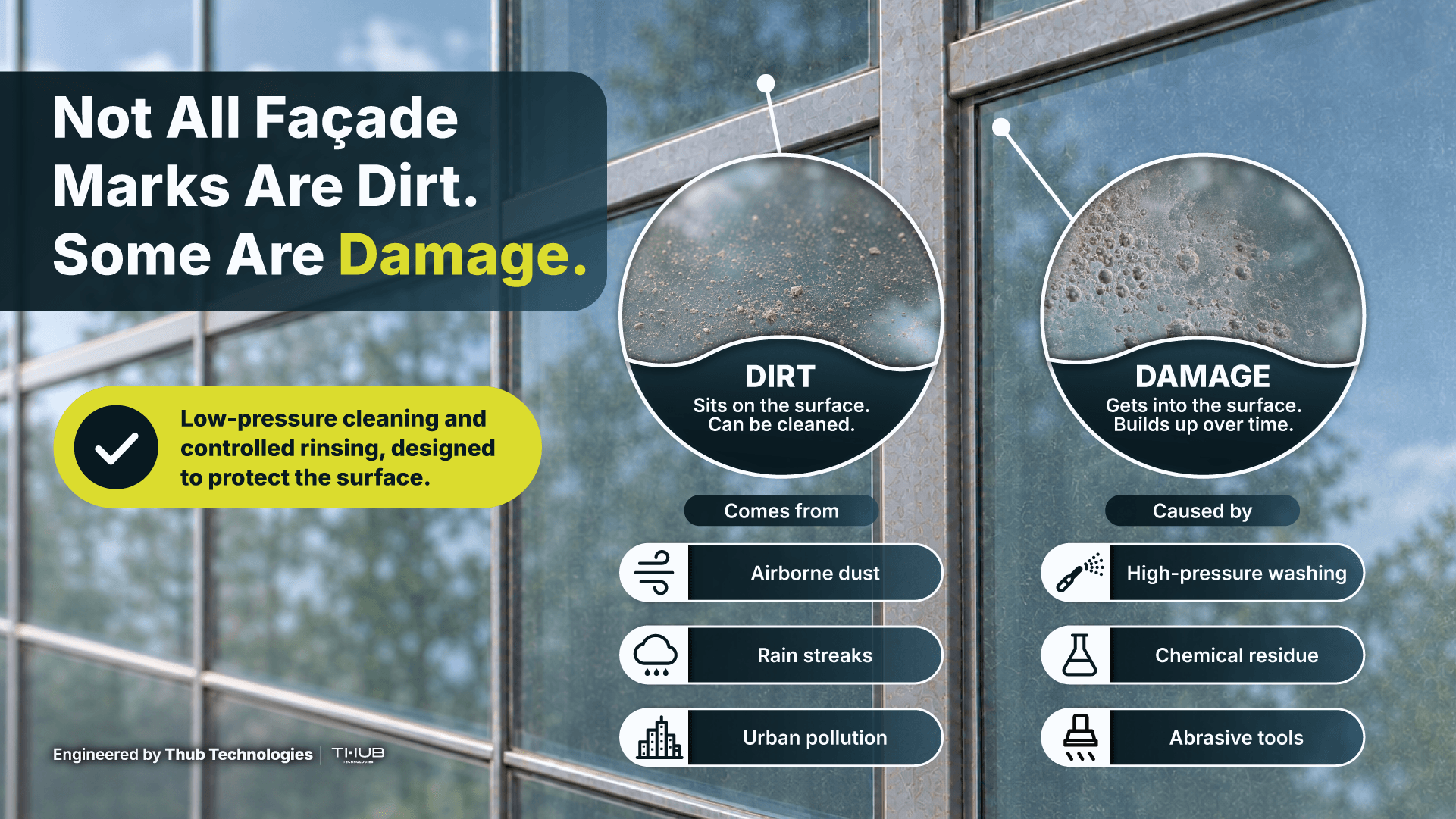
Most Façade Issues Aren't Dirt
When a building’s exterior looks tired, the instinct is usually to clean it. Dirt is visible, easy to describe and simple to put on a maintenance schedule. But a façade is more than a surface to be kept tidy. It is a building envelope, and its condition affects safety, performance, appearance and long-term asset value.
For owners and facility teams, the more useful question is not “How dirty is the façade?” but “What condition is it actually in?”
Why Dirt Is Only the Visible Layer
Cleaning is an important part of façade care. It supports the appearance of a building and helps preserve surfaces over time. However, a clean façade is not necessarily a healthy one, and a soiled one may be hiding more than grime.
Staining, discolouration or surface wear can be early indicators of issues that need closer examination. Without a structured way to look beyond the surface, these signals are easy to miss or misread.
What Cleaning Alone Cannot Tell You
Condition Is Not the Same as Cleanliness
A cleaning cycle answers one question: has the surface been cleaned? It does not by itself record how materials, joints, finishes and fixings are ageing. Façade maintenance works best when cleaning and inspection are treated as connected activities rather than separate tasks.
Small Issues Rarely Announce Themselves
Minor surface changes are often the first sign that a façade needs attention. Identified early, they can be planned for and managed. Left unobserved, they can become larger and more disruptive matters. Regular, consistent observation helps teams move from reacting to problems to planning for them.
The Challenge of Inspecting at Height
Traditionally, inspecting tall or complex buildings has meant work-at-height. Access methods can be time-consuming, weather-dependent and demanding to coordinate, particularly around occupied buildings, airports, hospitals and busy shopping centres.
Visual checks from the ground or from a distance have limits. Inspection quality can vary between teams, and findings are not always recorded in a way that can be compared over time. Both factors make it harder for property managers and building owners to build a reliable picture of façade condition.
How Robotic Technology Changes the Approach
Towercraft develops robotic technology for building exterior maintenance, façade cleaning and inspection, with the aim of making work on high-rise and complex structures safer, more efficient and more data-driven. The focus is on the façade as a whole, not on cleaning in isolation.
AI-Assisted Inspection and Surface Analysis
Robotic systems can carry imaging technology across a façade in a consistent, repeatable way. AI-assisted analysis can then help interpret what the cameras capture, supporting surface analysis and helping highlight areas that may merit closer attention. The technology supports the judgement of qualified professionals rather than replacing it.
Real-Time Video and Smart Reporting
Real-time video transmission lets teams observe façade conditions as work is carried out, rather than waiting for a later review. Findings can also feed into smart maintenance reporting, creating a structured record of what was seen and where.
Over time, this kind of record supports data-driven maintenance. Teams can compare conditions between visits, prioritise attention and plan resources with greater clarity.
Supporting Safer Work at Height
Reducing the amount of manual work carried out at height is one of the clearest benefits of robotic façade maintenance. When automation takes on repetitive or difficult-to-access tasks, fewer people need to be exposed to those conditions.
For health and safety professionals, this fits a wider commitment to managing risk thoughtfully. Robotic systems do not remove the need for planning, supervision or sound safety practice, but they can be a valuable part of a more careful approach to working on tall structures.
Façade Data in an ESG Context
Sustainability and ESG-focused organisations increasingly look for evidence of how their assets are managed. Consistent inspection records and clear maintenance reporting contribute to transparent asset management and support informed, long-term decisions.
A well-maintained building envelope also reflects a broader commitment to responsible stewardship of large real estate assets. Better information allows maintenance to be planned deliberately, which supports operational efficiency and more considered use of resources.
Looking Beyond the Surface
Façade care is changing. Cleaning remains essential, but it is becoming one part of a wider, more connected approach that combines robotic cleaning, AI-assisted inspection and structured reporting.
For building owners, property managers and facility management companies, this shift offers a clearer view of what is happening across the building envelope, and a stronger foundation for safe, efficient and sustainable maintenance.
Towercraft’s engineering-led approach reflects this direction: treating the façade as a system to be understood, not just a surface to be cleaned. As expectations for safety, transparency and data-driven decision-making continue to grow, looking beyond the surface will increasingly define good façade management.