
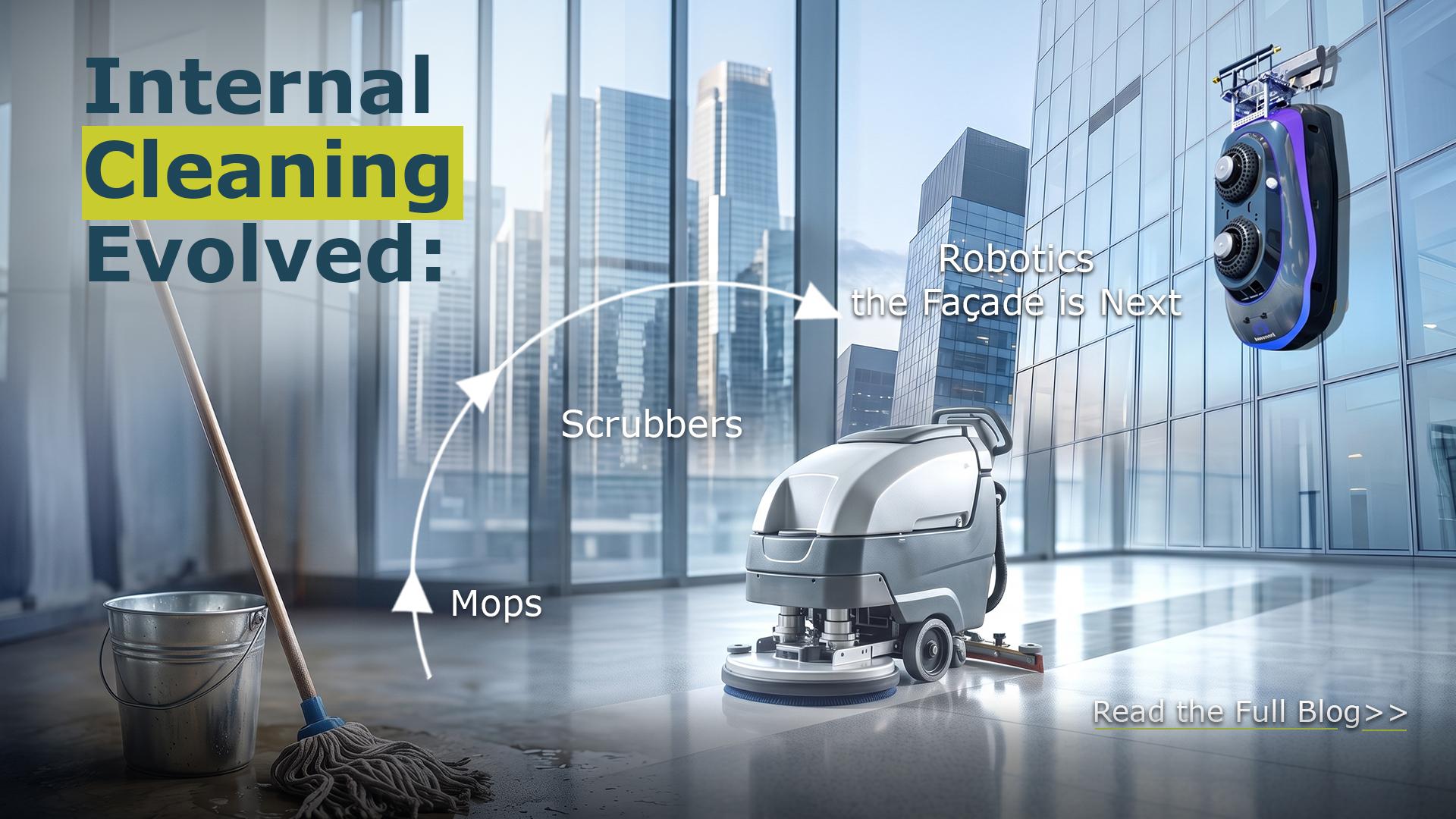
Internal Cleaning Evolved: Mops → Scrubbers → Robotics — The Façade Is Next
From Mops to Machines: How the Cleaning Evolution Is Finally Reaching the Building Façade
The history of building maintenance tells a clear story of progress. Inside commercial buildings, cleaning has evolved steadily — from manual labour with buckets and mops, to industrial scrubber-dryers, to today's automated floor-cleaning machines that operate with minimal human intervention. Each transition brought greater consistency, improved safety outcomes, and more efficient use of resources.
Yet for decades, the building façade remained largely untouched by this same wave of innovation. High-rise exterior maintenance continued to rely on rope access operatives and suspended scaffolding — methods that are resource-intensive, weather-dependent, and carry inherent risks for workers operating at significant height. The exterior of a building, arguably one of its most visible and structurally significant assets, was left behind by the very evolution that had transformed its interior.
That gap is now beginning to close.
The Interior Precedent: Why the Analogy Matters
Understanding where façade maintenance is heading requires looking at what already happened inside. The shift from manual mopping to automated scrubbers was not simply about convenience — it was driven by a convergence of pressures: rising labour costs, tighter health and safety standards, growing demands for operational efficiency, and the need for auditable, consistent outcomes.
Facility managers adopted automated cleaning solutions because they offered something manual processes could not: repeatable performance, reduced exposure to workplace hazards, and data that could inform scheduling and resource planning. The technology served operational and governance goals simultaneously.
The parallels for exterior maintenance are direct. Building owners and property managers face identical pressures when it comes to their façades. Manual work-at-height operations are costly, complex to schedule, and create measurable safety risks. Documentation of inspection outcomes has historically been inconsistent. And as sustainability expectations grow — driven by ESG commitments and wider regulatory trends — the ability to demonstrate responsible, data-driven asset management is becoming increasingly important.
Robotics Arrives at the Façade
Towercraft represents the application of this same logic to the building exterior. Rather than treating façade maintenance as a purely manual, periodic task, Towercraft brings robotics, automation, and AI-assisted technology to the process — making it more structured, safer, and more informative.
At its core, Towercraft's approach removes the need for operatives to work at dangerous heights for routine maintenance and inspection tasks. Robotic systems move across building exteriors to carry out cleaning and surface work, with real-time video transmission allowing remote monitoring throughout operations.
Beyond cleaning itself, the technology incorporates AI-assisted imaging and surface analysis capabilities. This means that a maintenance operation is not simply a cleaning pass — it becomes an opportunity to capture structured data about the façade's condition. Anomalies, surface deterioration, or areas requiring closer attention can be identified and documented in a way that informs future maintenance planning.
What This Means for Building and Facility Management
For property managers and facility management professionals, the significance of this shift goes beyond health and safety — though that element alone is substantial.
Consistency and Auditability: Where manual inspection methods produce variable outcomes depending on individual operatives, robotic and AI-assisted systems can deliver structured, repeatable assessments. This supports more defensible maintenance records and clearer reporting for building owners.
Smarter Maintenance Planning: When façade condition data is captured systematically, maintenance decisions can be made on the basis of evidence rather than assumption. This contributes to more efficient use of resources, avoiding both over-maintenance and the risks associated with issues going undetected.
Supporting ESG and Sustainability Goals: Data-driven maintenance practices align with the broader push towards responsible asset management. For organisations with ESG frameworks and sustainability commitments, demonstrating that building operations are managed with rigour and care for workforce safety carries genuine value.
Relevance Across Asset Types: The need for structured, technology-supported façade maintenance is not confined to one building type. Airports, hospitals, shopping centres, and large commercial buildings all manage significant exterior surfaces — and all carry corresponding responsibilities for safety, compliance, and asset preservation.
The Broader Trajectory
The evolution from mops to scrubbers to autonomous floor machines did not happen overnight, nor did it eliminate the role of skilled facility management professionals. It changed how those professionals worked — freeing them from the most hazardous and repetitive tasks while providing them with better information to make decisions.
The same trajectory is unfolding at the building façade. Robotics and AI-assisted inspection technologies are not replacing expertise in building maintenance — they are augmenting it. The result is a maintenance process that is more consistent, more transparent, and better aligned with the standards that modern building owners, regulators, and sustainability frameworks increasingly require.
For the facility management sector, the question is less about whether this evolution will continue, and more about when each organisation chooses to engage with it.