
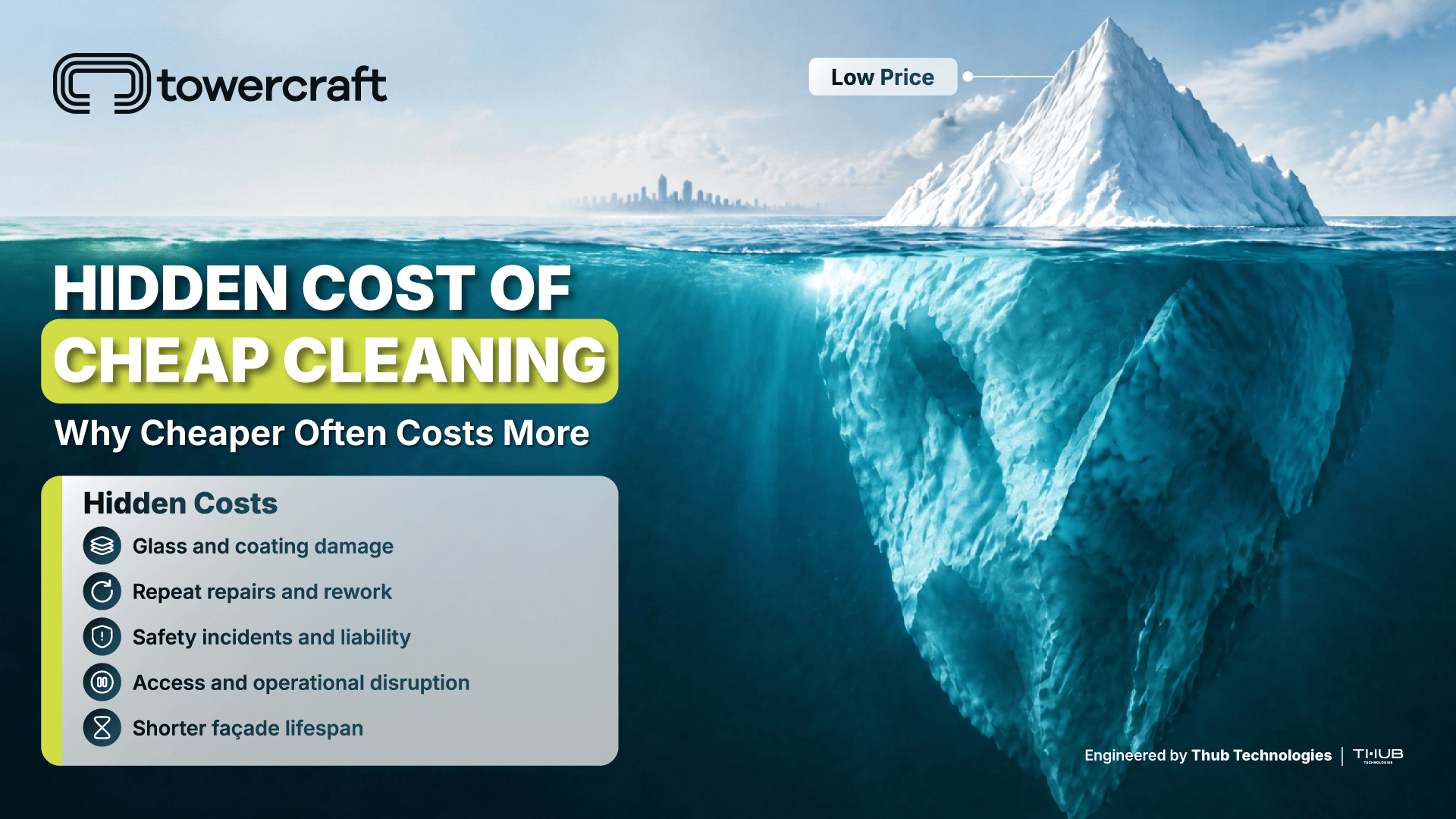
Hidden Cost of Cheap Cleaning
When façade cleaning contracts are reviewed, the lowest quote often looks like the obvious choice. Yet for building owners and facility managers, the true cost of façade maintenance rarely sits on the invoice.
It appears later: in damaged surfaces, repeat visits, safety exposure and decisions made without reliable data. Understanding these hidden costs is the first step towards a more sustainable, data-driven approach to building care.
Why the Lowest Price Rarely Reflects the Real Cost
A façade cleaning quote typically covers labour, access equipment and time on site. What it seldom captures is everything that happens afterwards.
Low-cost approaches often reach their price by reducing preparation, compressing schedules or limiting the care applied to each surface. The work may look acceptable on the day, but the asset owner can be left carrying costs that surface months later.
Surface Damage and Shortened Asset Life
Façades are among the most valuable and exposed elements of any building. Glass, cladding, sealants and coatings each respond differently to cleaning methods.
Inconsistent pressure, unsuitable techniques or rushed work can contribute to scratching, seal deterioration or coating wear. These issues are rarely visible straight away, yet they can bring forward the need for repair or replacement, turning a saving on cleaning into a capital expense.
Repeat Work and Operational Disruption
When cleaning quality is inconsistent, repeat visits become more likely. Each one means further access arrangements, more disruption for occupants and more time spent by facility teams coordinating contractors.
For airports, hospitals and shopping centres, where operations cannot easily pause, that disruption carries a cost of its own.
The Safety Cost of Work at Height
Conventional façade cleaning relies heavily on people working at height, using rope access, cradles or mobile platforms. Work-at-height remains one of the most significant risk areas in building maintenance.
When budgets are squeezed, pressure can fall on planning, supervision and equipment: the very areas that matter most for safety. An incident affects the people involved first and foremost, but it also brings operational interruption, reputational impact and closer scrutiny from health and safety stakeholders.
Reducing human exposure at height is therefore not only an ethical consideration. It is a practical risk management decision.
The Least Visible Cost: Lost Information
A cleaning team on a façade has a direct view of the building envelope, yet that view is rarely recorded or analysed in a structured way.
Cracks, sealant failures, corrosion or signs of water ingress can go unnoticed until they become serious problems. Without documented observations, maintenance stays reactive, and budgets are spent responding to issues rather than preventing them.
From Cleaning Visit to Inspection Opportunity
Every cleaning cycle can also be a chance to understand the condition of the building. Pairing cleaning with AI-assisted inspection, surface analysis and imaging turns a routine task into a source of maintenance data.
This supports data-driven maintenance planning, helping facility managers prioritise interventions and justify budgets with evidence rather than assumption.
How Robotic Façade Maintenance Changes the Equation
Robotic façade maintenance technology, such as that developed by Towercraft, approaches the problem differently. Rather than treating cleaning as an isolated, price-driven task, it treats the façade as an asset to be maintained, monitored and understood.
Robotic systems can help to:
- reduce the need for people to work at height during cleaning operations
- apply a more consistent, controlled cleaning process across the surface
- capture the façade through real-time video transmission and AI-assisted imaging
- produce smart maintenance reports that support long-term planning
For building owners and property managers, this means a clearer view of both the cleaning outcome and the condition of the façade itself.
Sustainability and ESG Considerations
Façade maintenance also has an environmental dimension. Repeat work, unnecessary resource use and premature replacement of building components all add to a building's footprint.
More controlled, data-informed maintenance can support organisations working towards ESG objectives, helping to extend asset life and make resource use more efficient and measurable.
Rethinking Value in Façade Maintenance
The most cost-effective façade maintenance strategy is rarely the cheapest one on paper. Decision-makers are increasingly looking beyond the quote to ask broader questions: How safe is the method? How consistent is the outcome? What will we know about our building once the work is done?
The answers point towards an approach where safety, operational efficiency and data carry as much weight as price. As robotics, automation and AI-assisted inspection mature, façade maintenance is shifting from a recurring expense to a strategic part of smart building management. Towercraft's focus is on supporting that shift, helping the people responsible for buildings care for them more safely, efficiently and with greater insight.