
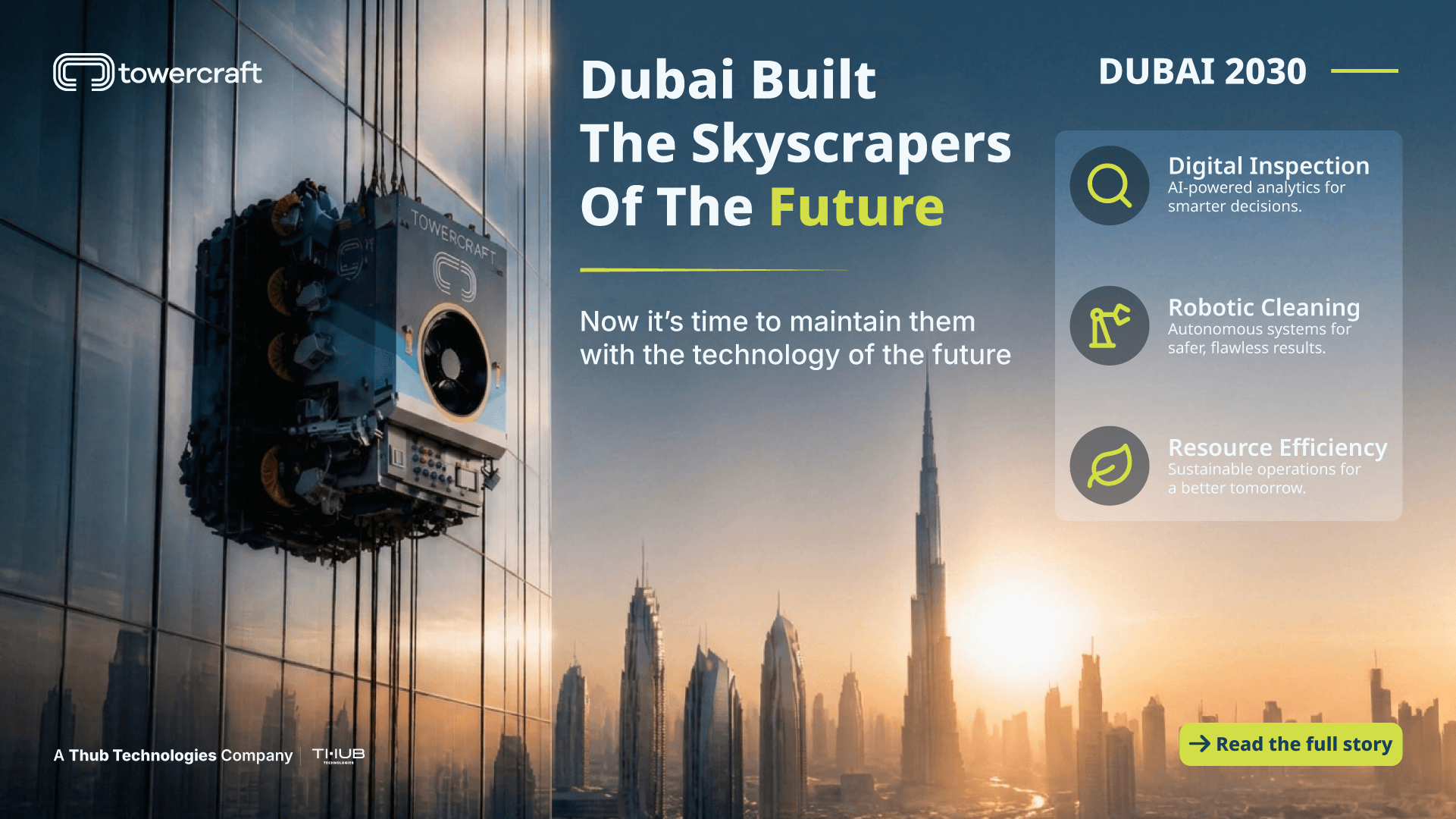
Dubai 2030: Why the World’s Most Advanced Skyline Needs a New Standard for Façade Maintenance
Dubai is not only a city that designs the future. It is a city that must operate the future, every day.
The city’s global success is visible in landmarks such as Burj Khalifa, Dubai Marina, Downtown Dubai and a new generation of mixed-use developments. Yet as 2030 approaches, the central question is no longer how much higher Dubai can build. The more consequential question is how a building portfolio of this scale can be protected with less risk, fewer resources, more consistent quality and stronger data.
Towercraft addresses that question directly. It does not treat façade cleaning as a purely visual service. It brings robotic operation, surface protection, digital inspection and documented evidence into one workflow. In a city defined by high-rise density, demanding climate conditions and uncompromising service expectations, that proposition is more than a technology demonstration. It describes the next operating model for façade maintenance.
Dubai’s 2030 agenda is raising the standard of building operations
The UAE’s strategic direction is clear. The UAE Green Agenda 2030 places a sustainable environment, clean energy and climate action, and the responsible use of resources within the country’s development programme. We the UAE 2031 calls for infrastructure and government performance to advance through the latest technologies. The UAE Net Zero 2050 Strategy identifies buildings as one of six priority sectors in the national transition.
Dubai translates that national direction into specific building and resource policies. Al Sa’fat – Dubai Green Building System establishes mandatory sustainability requirements for new buildings and encourages higher levels of performance. The Dubai Demand Side Management Strategy 2050 retains a target of at least 30 per cent savings in electricity, water and fuel consumption by 2030. These frameworks do not endorse a particular robot. They do, however, make the direction of value unmistakable: technologies that reduce human exposure, control resource use, document performance and integrate with existing infrastructure will become more relevant.
Façade management can therefore no longer sit inside a narrow cleaning budget. It now intersects with facilities management, occupational safety, asset protection, water efficiency, brand reputation and ESG reporting.
Dubai has built one of the world’s most advanced skylines. Its next advantage will come from maintaining that skyline with systems of equal ambition.
A façade is more than a building’s public face
A modern façade may combine glass, aluminium, composite panels, coated metals, joints, seals and ventilation elements. It is also the building’s largest interface with the external environment. Dubai’s intense solar exposure, high temperatures, humidity cycles, airborne dust and sand create continuous contamination and material stress. Dirt does more than weaken appearance. It can obscure oxidation, coating deterioration, joint defects and early signs of water ingress.
For hotels, office towers, shopping centres, airports, hospitals and mixed-use developments, the consequences are commercial. Façade condition affects tenant experience, visitor perception, brand equity and long-term maintenance cost. In Dubai, a building envelope is not simply an architectural shell. It is the visible expression of the city’s quality standard.
The maintenance method matters. Aggressive pressure, incorrect chemistry or repeated treatment that ignores the surface type can place unnecessary stress on coatings, seals and sensitive interfaces. The next generation of maintenance must understand the surface, classify the contamination and control the intervention rather than applying the same wash cycle to every elevation.
The limitation of traditional methods is the operating model
Rope-access teams, cradles and mobile elevating work platforms remain necessary for many specialist tasks. The issue is not the capability of the workforce. The issue is an operating model that repeatedly places skilled people at height, in heat and in changing weather conditions across large, recurring façade programmes.
Manual output can vary with team experience, access angle, shift conditions and application discipline. Different elevations on the same building may receive different results. Once the work is complete, detailed surface evidence is often limited. The next team cannot compare the current condition with a reliable digital record of the previous cycle. The building gets cleaned again, but the organisation does not accumulate intelligence about the asset.
At Dubai’s scale, small inefficiencies multiply across large portfolios. Excess water, avoidable chemical use, repeat visits, access preparation, disruption and human-hours spent at height all increase total cost. The new standard should not be more labour. It should be a more controlled, repeatable and auditable operation.
Why Towercraft is a natural fit for Dubai
Towercraft’s strongest advantage is that it does not ask Dubai to redesign its buildings. The system is engineered to work with existing Building Maintenance Units, monorails, mobile cranes or suitable suspension infrastructure. This turns robotic maintenance from a separate architectural project into an intelligent use of access equipment already present on the asset.
Semi-autonomous movement, remote operation, real-time visibility and AI-assisted routing and surface analysis support a more consistent workflow. Towercraft is developed for glass, aluminium, composite panels, coated metal and mixed façade elements. According to the company’s published technical information, selected models can support operating heights of up to 300 metres. Actual capacity depends on building geometry, access equipment, surface type and site conditions.
Resource efficiency is equally relevant to the UAE. Towercraft reports that suitable applications can use up to 80 per cent less water and up to 60 per cent less chemical than manual cleaning. Its controlled, low-pressure and mechanical-brushing approach is designed to treat the contamination rather than simply saturate the surface. In Dubai’s water-efficiency context, that difference is not a minor marketing claim. It is a measurable operational metric.
The deeper advantage is repeatability. A robot can reproduce the same movement, defined pressure and specified cleaning cycle. Quality becomes less dependent on the individual operator. Across large elevations, outcomes become more predictable. The facilities manager receives more than a completion notice; the organisation can see where, when and under what conditions the work took place.
From cleaning to façade intelligence
What separates Towercraft from a conventional cleaning machine is its capacity to generate operational data. Integrated cameras, real-time video and AI-assisted review can make contamination, oxidation, surface deterioration and unusual conditions around joints and interfaces more visible. This evidence does not replace a façade engineer, fire consultant or specialist inspector. It enables those professionals to focus earlier, on the right location and with stronger evidence.
The future of façade management will not be a single annual cleaning calendar. Building owners will maintain a digital condition history for each elevation. Previous and current images will be compared. Re-soiling rates will be observed. Traffic-facing sides, shaded surfaces, wind-exposed elevations and sensitive interfaces will move onto different maintenance cycles. Budgets will be allocated according to condition and risk rather than treating the entire building at the same frequency.
This changes the façade from a recurring cost centre into a manageable data asset. Towercraft’s real opportunity in Dubai lies here. As the city advances smart metering, AI-enabled public services and measurable energy performance, turning the building envelope into a source of operational intelligence is a logical next step.
A practical outcome for Dubai: less exposure, stronger evidence
The first outcome is safety. A robotic system can materially reduce the time people spend working at height and their direct exposure to fall hazards. The operation still requires a risk assessment, suitable suspension, exclusion zones, trained operators and emergency procedures. The centre of the risk profile nevertheless changes. The person moves from being the primary workforce on the façade to becoming the specialist who controls and supervises the system from a safer position.
The second outcome is resource control. Water and chemical consumption can be recorded. Application pressure and cleaning cycles can be standardised. Facilities teams can purchase comparable performance data rather than receiving only a service invoice.
The third outcome is operational continuity. Hotels, airports, hospitals, retail destinations and occupied office towers need maintenance with minimal disruption. Faster mobilisation, repeatable movement across broad surfaces and predictable shift planning protect the user experience and simplify site coordination.
The fourth outcome is governance. Time-stamped footage, before-and-after records, surface observations and operational reports give FM, HSE, procurement, finance and ESG teams different but verifiable views of the same activity. The factor that will earn Towercraft acceptance is not the size of the claim. It is the strength of the evidence.
The right model for UAE adoption: local capability and a measurable pilot
The UAE welcomes advanced technology, but it does not adopt technology on novelty alone. Decision-makers require a credible safety case, a clear technical-approval path, local service capacity, training, spare parts, insurance, method statements and proof on site. Towercraft’s strongest route into Dubai is therefore not an immediate portfolio-wide replacement. It is a controlled pilot on a high-visibility building or a single elevation.
The pilot should measure specific outcomes: time per square metre, water and chemical consumption, mobilisation time, rework, reduction in human-hours at height, surface quality, operational disruption and maintenance findings. Towercraft’s advantage is its ability to make many of these indicators visible. Acceptance will not come from believing a presentation. It will come from comparing results on the same asset under the same conditions.
For local facilities-management companies, Towercraft does not need to be positioned as a replacement. It can operate as a specialist layer that supports existing teams on large, repetitive and higher-risk elevations. Human teams can focus on detail work, internal areas, sensitive interfaces and specialist repairs while the robot takes on broad recurring coverage. This does not devalue skilled labour. It moves skilled people away from hazardous, repetitive work and towards control, analysis, maintenance planning and technical decisions.
The same approach supports the UAE’s ambitions for technology transfer and capability development. Local operator training, a regional service centre, university and engineering partnerships, product development informed by field data, and maintenance protocols optimised for GCC conditions would turn Towercraft from an imported machine into a platform that creates local value.
Dubai’s future should be visible in its maintenance standard
Dubai has shown the world how quickly and ambitiously a city can build. As 2030 approaches, the next field of leadership will be how intelligently, safely and efficiently those assets are operated.
Leading property portfolios will no longer ask only, ‘When was the façade cleaned?’ They will ask, ‘What was its condition, how much water was used, which risks were reduced, what findings were recorded and what changed since the previous cycle?’ Towercraft has the potential to answer those questions within one operating workflow.
Dubai is therefore more than a large target market for Towercraft. The city’s architectural scale, openness to technology, safety expectations and sustainability commitments make it a natural reference centre for robotic façade maintenance. A model proven in Dubai could become a powerful example for high-rise asset management from London and Riyadh to Singapore and New York.
One of the world’s most recognisable skylines deserves the next generation of maintenance. Towercraft’s proposition is precise: safer façade operations, more controlled use of resources and stronger data from every maintenance cycle.
Editorial verification sources
The following official and primary sources were used to verify strategy names and published product statements. This section may be removed or converted into inline links to match the publication’s editorial policy.
- UAE Green Agenda 2030 — UAE Government
- We the UAE 2031 — UAE Government
- UAE Net Zero 2050 Strategy — UAE Government
- Al Sa’fat — Dubai Green Building System
- Dubai Demand Side Management Strategy 2050 — Dubai Supreme Council of Energy / DEWA
- Towercraft — Official product and technology information
- THUB Technologies — Towercraft platform overview