
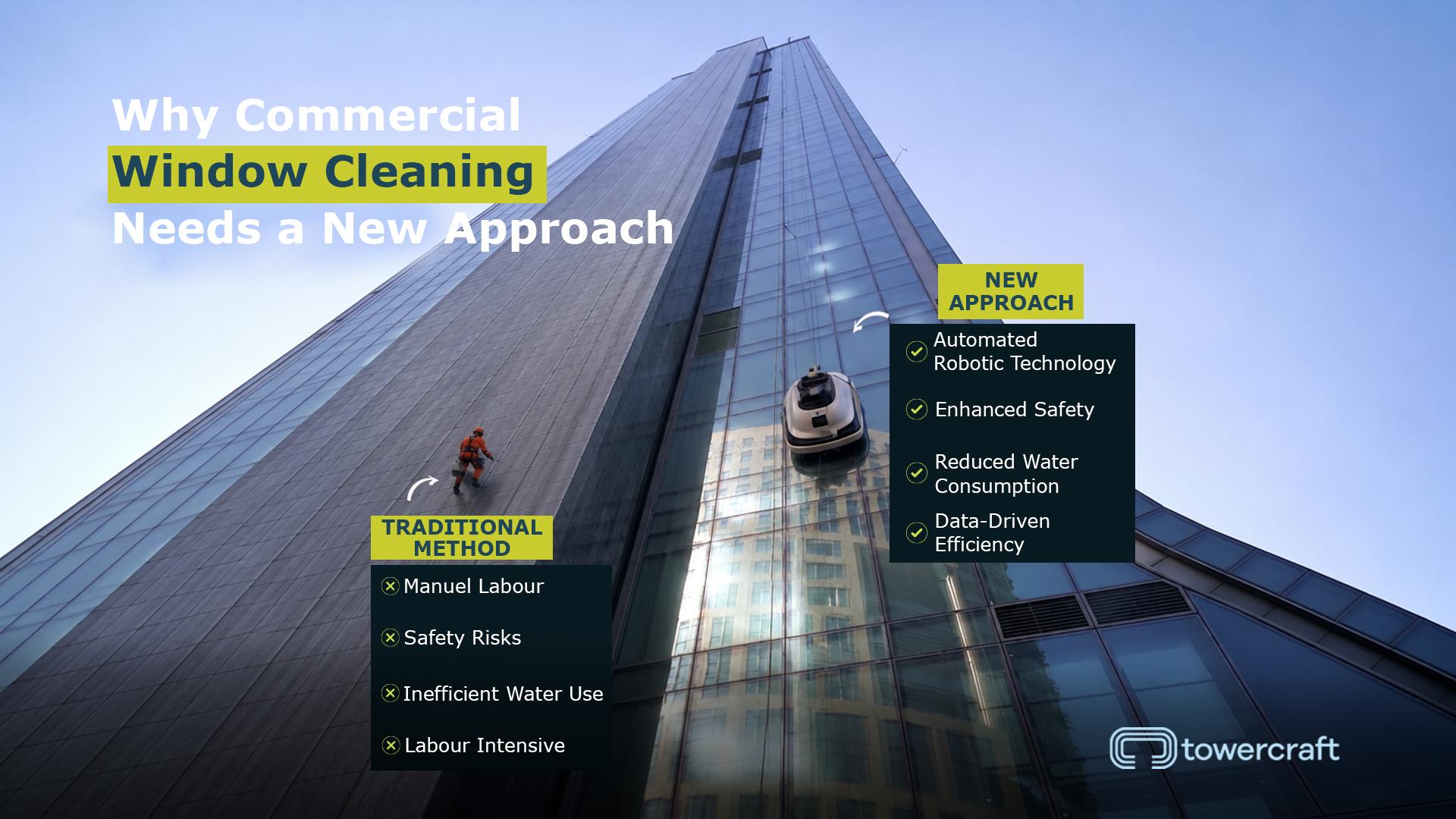
Why Commercial Window Cleaning Needs a New Approach
The image of a worker suspended by ropes against the glass face of a high-rise has long been accepted as a necessary reality of building maintenance. But as the built environment grows taller, more complex, and more accountable — to safety regulators, to ESG frameworks, and to the operational demands of modern asset management — that image is beginning to look increasingly outdated. The commercial window cleaning industry is at an inflection point, and the direction of change is clear.
The Limitations of Conventional Façade Cleaning
For decades, rope access and traditional scaffolding have been the default approach to cleaning and maintaining the exterior of commercial buildings. These methods carry inherent risks — for the operatives involved, for building occupants, and for the organisations that own or manage the asset. Work-at-height remains one of the most significant sources of workplace incidents across the construction and facilities management sectors, and façade maintenance sits firmly within that risk category.
Beyond safety, conventional approaches present operational challenges that are difficult to reconcile with the expectations of modern asset management. Manual cleaning cycles are often infrequent, difficult to document comprehensively, and dependent on weather conditions, workforce availability, and access equipment. For building owners and property managers overseeing large commercial portfolios, that level of variability is increasingly difficult to absorb.
There is also a quality and consistency question. A manual operative working at height has limited tools for identifying surface deterioration, sealant failure, or structural anomalies beyond what the naked eye can detect at close range. This means that minor defects can go unreported until they develop into costly repairs — a scenario that is entirely avoidable with the right technology in place.
A Structural Shift in Thinking About Façade Maintenance
The emergence of robotic technology in external building maintenance is not simply a response to safety concerns — though those concerns are significant. It reflects a broader shift in how facilities management and building operations are being understood and managed.
Modern asset owners are operating in an environment where data matters. Whether reporting to sustainability committees, ESG-focused investors, or internal operational teams, the ability to document building condition, maintenance activity, and compliance records with precision is no longer a nice-to-have. It is a core requirement of responsible asset management.
Robotic façade maintenance systems are designed to operate within this new paradigm. Rather than producing a cleaned surface and a manual sign-off sheet, they generate structured data: visual records, surface condition assessments, and maintenance logs that can be integrated into wider building management workflows. This shifts the nature of façade maintenance from a reactive, labour-intensive task to a proactive, intelligence-led process.
From Reactive to Predictive: The Role of Data in Modern Façade Care
One of the most significant changes that robotic technology introduces to façade maintenance is the capacity for ongoing monitoring and early identification of potential issues. AI-assisted imaging and real-time video capture allow surface conditions to be assessed with a level of detail and consistency that is not achievable through conventional inspection alone.
For facility managers and property teams responsible for large commercial assets — airports, shopping centres, hospitals, or multi-building estates — this capability transforms how maintenance planning is approached. Rather than scheduling inspections and cleaning on a calendar basis, teams can respond to condition-based data, allocating resources where they are genuinely needed and identifying developing issues before they require significant intervention.
This is not simply a matter of efficiency, though efficiency gains are a meaningful outcome. It is also about accountability. When maintenance decisions are grounded in documented, verifiable data, the organisations making those decisions are better protected — commercially, operationally, and from a health and safety perspective.
Safety, Sustainability, and the ESG Imperative
Work-at-height risk reduction is one of the clearest value propositions that robotic façade technology offers, and it is one that resonates strongly with health and safety professionals, insurers, and regulatory bodies alike. Reducing the number of operative hours spent at height on repetitive cleaning tasks is a meaningful contribution to workplace safety — one that does not require safety incidents to justify.
Sustainability considerations are equally relevant. Robotic systems can be designed to operate with optimised water and cleaning agent usage, reducing the environmental footprint of regular maintenance cycles. For organisations with formal sustainability commitments or ESG reporting obligations, this is an important dimension of façade maintenance that has historically been difficult to quantify or improve.
Building Towards a More Intelligent Maintenance Model
The commercial window cleaning industry has served the built environment reliably for generations, but the conditions that shaped it have changed considerably. Buildings are taller and more architecturally complex. Safety standards are more demanding. Asset owners are under greater pressure to demonstrate responsible stewardship. And the technology available to support smarter maintenance practices has advanced significantly.
Robotic façade maintenance is not a replacement for human expertise — skilled professionals remain essential to building management. What it represents is a meaningful augmentation of capability: safer working conditions, richer operational data, and a maintenance model that is better aligned with the demands of the modern built environment. For building owners, property managers, and facility management teams looking to strengthen their approach to façade care, understanding this technology and its role in the industry is a logical and timely step.