
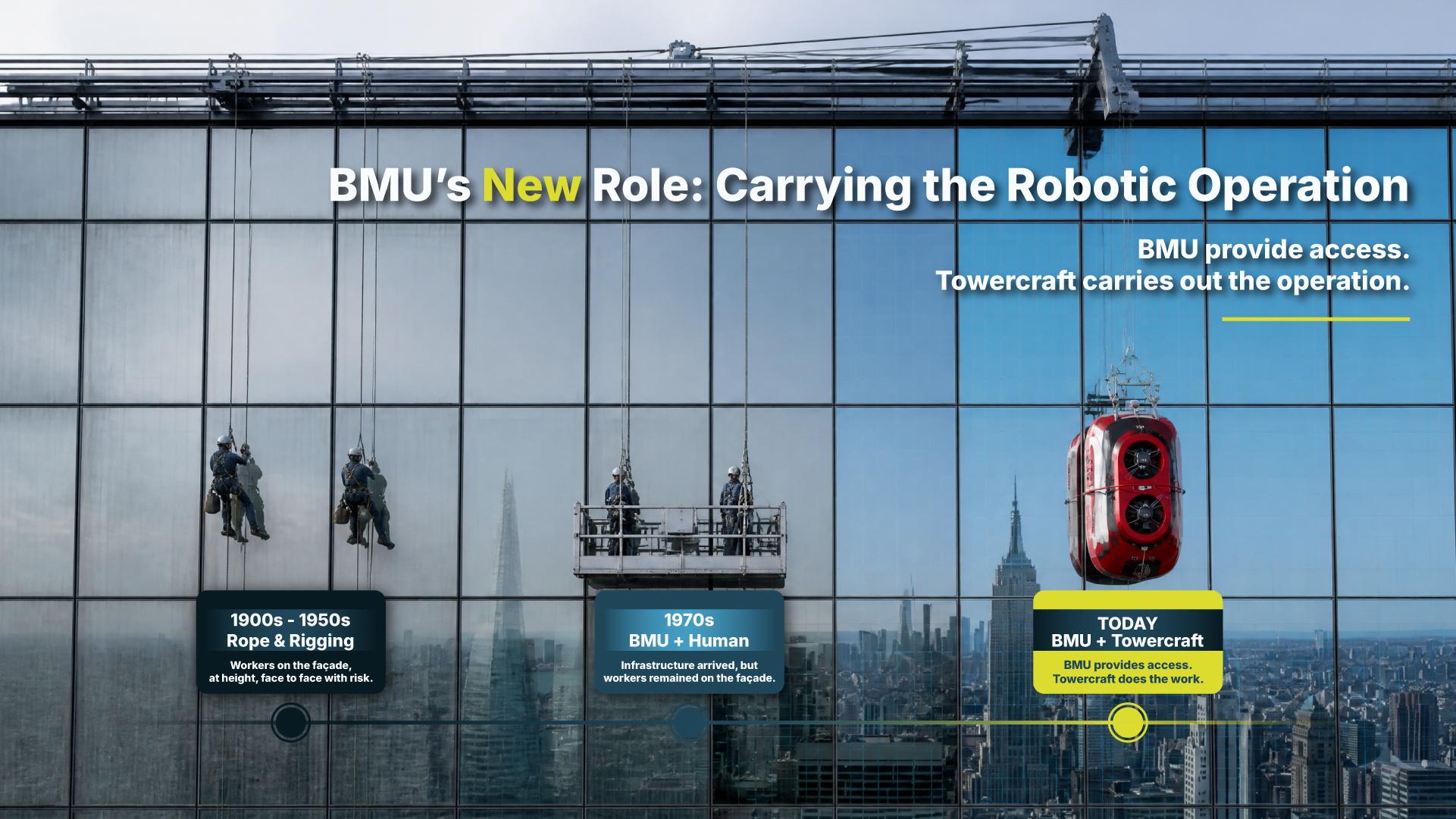
Towercraft is not a competitor to the BMU; it is auxiliary equipment that makes the BMU more valuable in the age of robotics
Key message: The BMU infrastructure should not be viewed as an outdated machine that excludes robotic front-line maintenance,
but rather as a strategic access infrastructure that has become even more valuable in the age of robotics.
All sectors worldwide are moving in the same direction. Technologies in manufacturing, logistics, defence, agriculture, healthcare, energy and
construction are relieving humans of the most hazardous, repetitive and quantifiable tasks. These fields are
being taken over by machinery, automation and robotic systems. This is no longer a distant future. According to data from the International
Federation of Robotics, 542,000 industrial robots were installed worldwide in 2024.
According to the same report, the number of industrial robots in active use worldwide reached 4,664,000
by the end of 2024. This data points to a clear trend: industry has entered the age of robots, and this transition is
irreversible. [1]
The building maintenance sector cannot remain on the sidelines of this development. High-rise buildings with glass façades, complex architectural
surfaces, hard-to-reach façades and the risks associated with working at height should no longer be addressed
solely by manned methods. BMU systems have not lost their importance at this stage. On the contrary, with the right robot
integration, they are becoming even more critical. This is because a robust, carefully engineered and properly managed access infrastructure is required for the robot to
descend safely onto the façade. This is precisely where the BMU
adds value.
Towercraft’s position in the market must therefore be correctly understood. Towercraft is not a competitor
to the BMU. Towercraft is the end-point equipment that makes the BMU more valuable in the age of robotics. The BMU is the
main support structure and access infrastructure. Towercraft, on the other hand, is the robotic cleaning,
inspection and data collection system operating at the end of this infrastructure. This distinction is important. The BMU provides access to the building’s façade.
Towercraft transforms this access into a safer, more measurable and more efficient operation.
The BMU, or Building Maintenance Unit, is generally permanent mechanical
access equipment installed at roof level. Eurosafe defines a BMU as equipment installed at roof level that provides permanent
mechanical access for the maintenance of a building’s façade. The same source explains that a BMU is used, via a basket or cradle
system, for maintenance, cleaning, repairs, glass replacement and façade panel replacement
along the façade. This definition demonstrates just how fundamental the BMU is as infrastructure for a building.
[2]
Until now, people have been at the heart of BMU systems. A person would board the basket. A person would descend to the façade.
A person would clean the glass. A person would inspect the panels. A person would work at high-risk locations. This model
was appropriate in its time. Because robotic façade cleaning and robotic façade maintenance were not a serious
option. However, conditions have now changed. Facade cleaning is no longer merely a matter of wiping windows.
Facade maintenance now requires data, imaging, repeatable routes, contamination monitoring, damage detection and
operational logging.
This change does not render the BMU obsolete. On the contrary, it expands the BMU’s remit. The old BMU merely
lowered people to the facade. The new generation of BMUs, however, must evolve into an infrastructure that supports manned operations whilst also
facilitating robotic operations. BMU manufacturers and service firms that recognise this difference early on
will gain a stronger foothold in the market. Those who fail to recognise it, however, will limit the future scope of application
for their own machines.
Today, some firms in the field are showing a reflexive resistance to robot integration. It is all too easy to say, “This system
cannot be connected to a robot.” However, this statement alone does not constitute an engineering solution.
If there is a technical risk, calculations are required. If the connection point is inadequate, a solution is required. If there is a capacity issue,
a redesign is required. Wind limits, power lines, data lines, secondary safety points, emergency
scenarios and test procedures must be defined. Simply saying “it won’t work” does not halt the market. It merely
directs the customer to other firms seeking solutions.
BMU manufacturers and maintenance firms must not stand in the way of this development. They must be the ones
generating solutions within this development. Because robotic front-end maintenance will be a growing market. BMU firms
that embrace this market will develop new modernisation revenues, new service models, new maintenance
packages and new technical interfaces. Companies that resist, however, will believe they are preserving the status quo
in the short term. In the long term, they will lose their place at the decision-making table.
Towercraft is not a system that takes work away from the BMU manufacturer at this stage. Towercraft is
robotic end-effectors that enhance the utility of the BMU. An existing BMU has a limited scope of operation
when used solely for manned access. When the same BMU is made robot-compatible, its scope of operation
expands. Cleaning operations are scheduled more frequently. The façade is inspected more regularly. Operations are recorded. Building management receives data following cleaning. This scenario does not diminish, but rather enhances, the BMU’s
importance within the building.
Towercraft’s own technical positioning is also in line with this. Towercraft is described as being designed to be installed on existing systems,
BMUs, monorails, and carrier infrastructures such as spider cranes and mobile cranes. The same source states that the robot moves vertically and horizontally along the building façade, is powered
by the building’s mains supply, and is operated by trained operators. This information
demonstrates that Towercraft is a system that utilises existing access infrastructure rather than eliminating the main support structure.
[3]
Therefore, it is not Towercraft that the BMU sector should fear. The real risk lies in being
unprepared for robotic integration. The market will no longer simply ask, ‘Is the BMU operational?’
It will ask, ‘Is this BMU ready for robotic façade cleaning and robotic façade inspection?’ In new
buildings, investors, architects, façade consultants and facility managers will begin to ask this question
at an earlier stage. In existing buildings, meanwhile, demands for modernisation will grow
around this theme.
The five-year exclusive agreement announced in 2024 between Alimak Group and Skyline Robotics clearly
demonstrates this trend. In its statement, Alimak indicated that the aim is to develop an integrated robotic BMU
that provides automated glass cleaning and façade maintenance. This step is no coincidence. Major
players in the vertical access sector are not leaving robotic technology out; they are incorporating it into their own systems.
This scenario sends a clear message to the BMU sector: robotic façade maintenance is not developing in opposition to the BMU;
it is changing the way the BMU will be used in the future. [4]
Building management teams must also interpret this change correctly. Manual façade work carries a high risk.
The UK’s Health and Safety Executive (HSE) first asks whether it is possible to avoid this work altogether when working at height.
If avoidance is not possible, it requires measures to prevent falls; if this is not possible, it requires measures to
minimise the distance of a fall and its consequences. The HSE also recommends that work be carried out at ground level
whenever possible. This approach leads to a clear conclusion in building maintenance: people should not descend to the façade
unnecessarily. People should manage the system; machinery should carry out risky work wherever possible. [5]
This risk is not theoretical. According to HSE’s provisional figures for 2025/26, 126 workers in the UK
lost their lives in workplace accidents. The same data shows that the most common cause of death was falls from height,
with 31 cases. This figure sends a clear message to the building maintenance sector: working at height remains one of the most critical
safety issues. Any technical development that protects human life must be taken seriously. [6]
Towercraft’s value lies not merely in keeping people away from the façade. Its true value is that it makes
façade maintenance more measurable. In traditional cleaning, operations often begin and
end on-site. The team cleans the glass, the job is completed, and building management is left with limited information. In robotic operations,
however, cleaning is carried out using a logic of repetitive routes, imagery, recording and monitoring. The
intensity of soiling on the façade, problem areas, surface damage, connection details and recurring maintenance
needs become more visible. This strengthens the building management’s ability to make informed maintenance decisions.
There is a significant opportunity here for BMU manufacturers. A company designing robot-compatible BMUs does not merely
sell machinery; it shapes the new standard for building maintenance. A company developing a robot interface
for existing BMU systems does not merely provide a service; it offers the building owner a more robust modernisation
solution. A company such as Towercraft, which establishes technical protocols with robotic end-effectors, does not merely
protect its existing product. It adapts its product to meet new market needs.
Companies that fail to recognise this opportunity are stuck repeating the same phrase: “It won’t connect.” However, this phrase does not
stop the market. Building owners continue to seek safer, faster and more documented solutions.
Facility management wants to minimise human risk. Occupational health and safety experts want lower exposure. Insurers
want more controlled operations. Facade consultants want more consistent data. Robotics firms
continue to develop solutions. Ultimately, those producing solutions in the market gain the upper hand. Those who resist
simply lag behind.
For this reason, management teams must address this issue as a matter of urgency. Whether it is a BMU manufacturer, a service provider
or building management, it makes no difference. Every management team must ask itself the same question: How can the BMU infrastructure we currently
possess become more valuable in the age of robotics? Those who answer this question
The company operates in a growing market. A company that postpones this issue will, a few years later,
respond too late to its customers’ expectations.
In existing buildings, the first step is to carry out a technical
assessment of the BMU system with regard to robot integration. Capacity calculations must be checked. Dynamic load behaviour must be assessed.
Connection points must be reviewed. If necessary, a mechanical adapter must be designed. Power and
data lines must be planned. A secondary safety system must be defined. Wind limits must be determined.
An emergency scenario must be drawn up. A test procedure must be established. This work is necessary not to connect the robot
in an uncontrolled manner, but to clarify the boundaries of safe integration.
In new buildings, however, the decision must be made at the design stage. It is no longer sufficient to ask only,
‘How will a person access the façade?’ The question, ‘How will a robot descend onto the façade?’ must also be answered.
Where will the robot be attached? Where will it draw its power from? How will it transmit data? At which point
will it be secured? At what wind limit will it stop? In which emergency situations will it be retrieved? If these
questions are resolved during the design phase, the BMU will be ready for the future. If these questions are postponed, the building will be trapped in the old maintenance mindset from the very
first day.
Towercraft should not be viewed here as an alternative to the BMU system, but rather as an end-point piece of equipment that complements the BMU’s new
role in the age of robotics. The main carrier is the BMU. Towercraft
is the on-site operational arm of the robotic system. These are not two mutually exclusive systems. With the right
engineering, they are two structures that reinforce one another. The BMU provides access. Towercraft carries out the work,
records it, monitors it and delivers clearer results to building management.
This approach is not a threat to BMU manufacturers. It is a new sales narrative. A new service area.
A new modernisation concept. A new project specification. A new maintenance standard. BMU firms that prepare for this
concept today will provide a stronger response to their customers tomorrow. Firms that merely resist
today, however, will be forced to comply with conditions set by others tomorrow.
The outcome is clear. Towercraft is not a competitor to BMUs. Towercraft is the cutting-edge equipment that makes BMUs more valuable
in the age of robotics. The global machinery and robotics industry has moved on. The building maintenance sector is also
moving in this direction. A company that stands in the way of this development does not produce solutions. It merely distances its own customers and
its own products from the needs of the future.
The BMU sector must urgently embrace this change. Existing BMU systems must be assessed
for robot compatibility. New BMU systems must be designed ready for robot integration.
Companies that know how to work with robotic end-effectors, such as Towercraft, will come to the fore
in this new phase of the market. Those who resist will lag behind the sector.
The future standard for building maintenance is clear. Humans manage risk. Machines work on the façade. BMUs
provide access. Towercraft transforms this access into robotic cleaning, monitoring and data. Management teams that
understand this model early on will both enhance human safety and make their BMU investments more
valuable.
Sources
[1] International Federation of Robotics – World Robotics 2025 report – Industrial Robots (ifr.org)
[2] Eurosafe – Building Maintenance Units (BMU) (www.eurosafeuk.com)
[3] THUB Technologies – Towercraft (thubtechnologies.io)
[4] Alimak Group - Alimak Group invests in robotics technology for building maintenance
(corporate.alimakgroup.com)
[5] HSE - Introduction to working at height safely (www.hse.gov.uk)
[6] HSE Media Centre - Latest annual work-related fatalities published (press.hse.gov.uk)
but rather as a strategic access infrastructure that has become even more valuable in the age of robotics.
All sectors worldwide are moving in the same direction. Technologies in manufacturing, logistics, defence, agriculture, healthcare, energy and
construction are relieving humans of the most hazardous, repetitive and quantifiable tasks. These fields are
being taken over by machinery, automation and robotic systems. This is no longer a distant future. According to data from the International
Federation of Robotics, 542,000 industrial robots were installed worldwide in 2024.
According to the same report, the number of industrial robots in active use worldwide reached 4,664,000
by the end of 2024. This data points to a clear trend: industry has entered the age of robots, and this transition is
irreversible. [1]
The building maintenance sector cannot remain on the sidelines of this development. High-rise buildings with glass façades, complex architectural
surfaces, hard-to-reach façades and the risks associated with working at height should no longer be addressed
solely by manned methods. BMU systems have not lost their importance at this stage. On the contrary, with the right robot
integration, they are becoming even more critical. This is because a robust, carefully engineered and properly managed access infrastructure is required for the robot to
descend safely onto the façade. This is precisely where the BMU
adds value.
Towercraft’s position in the market must therefore be correctly understood. Towercraft is not a competitor
to the BMU. Towercraft is the end-point equipment that makes the BMU more valuable in the age of robotics. The BMU is the
main support structure and access infrastructure. Towercraft, on the other hand, is the robotic cleaning,
inspection and data collection system operating at the end of this infrastructure. This distinction is important. The BMU provides access to the building’s façade.
Towercraft transforms this access into a safer, more measurable and more efficient operation.
The BMU, or Building Maintenance Unit, is generally permanent mechanical
access equipment installed at roof level. Eurosafe defines a BMU as equipment installed at roof level that provides permanent
mechanical access for the maintenance of a building’s façade. The same source explains that a BMU is used, via a basket or cradle
system, for maintenance, cleaning, repairs, glass replacement and façade panel replacement
along the façade. This definition demonstrates just how fundamental the BMU is as infrastructure for a building.
[2]
Until now, people have been at the heart of BMU systems. A person would board the basket. A person would descend to the façade.
A person would clean the glass. A person would inspect the panels. A person would work at high-risk locations. This model
was appropriate in its time. Because robotic façade cleaning and robotic façade maintenance were not a serious
option. However, conditions have now changed. Facade cleaning is no longer merely a matter of wiping windows.
Facade maintenance now requires data, imaging, repeatable routes, contamination monitoring, damage detection and
operational logging.
This change does not render the BMU obsolete. On the contrary, it expands the BMU’s remit. The old BMU merely
lowered people to the facade. The new generation of BMUs, however, must evolve into an infrastructure that supports manned operations whilst also
facilitating robotic operations. BMU manufacturers and service firms that recognise this difference early on
will gain a stronger foothold in the market. Those who fail to recognise it, however, will limit the future scope of application
for their own machines.
Today, some firms in the field are showing a reflexive resistance to robot integration. It is all too easy to say, “This system
cannot be connected to a robot.” However, this statement alone does not constitute an engineering solution.
If there is a technical risk, calculations are required. If the connection point is inadequate, a solution is required. If there is a capacity issue,
a redesign is required. Wind limits, power lines, data lines, secondary safety points, emergency
scenarios and test procedures must be defined. Simply saying “it won’t work” does not halt the market. It merely
directs the customer to other firms seeking solutions.
BMU manufacturers and maintenance firms must not stand in the way of this development. They must be the ones
generating solutions within this development. Because robotic front-end maintenance will be a growing market. BMU firms
that embrace this market will develop new modernisation revenues, new service models, new maintenance
packages and new technical interfaces. Companies that resist, however, will believe they are preserving the status quo
in the short term. In the long term, they will lose their place at the decision-making table.
Towercraft is not a system that takes work away from the BMU manufacturer at this stage. Towercraft is
robotic end-effectors that enhance the utility of the BMU. An existing BMU has a limited scope of operation
when used solely for manned access. When the same BMU is made robot-compatible, its scope of operation
expands. Cleaning operations are scheduled more frequently. The façade is inspected more regularly. Operations are recorded. Building management receives data following cleaning. This scenario does not diminish, but rather enhances, the BMU’s
importance within the building.
Towercraft’s own technical positioning is also in line with this. Towercraft is described as being designed to be installed on existing systems,
BMUs, monorails, and carrier infrastructures such as spider cranes and mobile cranes. The same source states that the robot moves vertically and horizontally along the building façade, is powered
by the building’s mains supply, and is operated by trained operators. This information
demonstrates that Towercraft is a system that utilises existing access infrastructure rather than eliminating the main support structure.
[3]
Therefore, it is not Towercraft that the BMU sector should fear. The real risk lies in being
unprepared for robotic integration. The market will no longer simply ask, ‘Is the BMU operational?’
It will ask, ‘Is this BMU ready for robotic façade cleaning and robotic façade inspection?’ In new
buildings, investors, architects, façade consultants and facility managers will begin to ask this question
at an earlier stage. In existing buildings, meanwhile, demands for modernisation will grow
around this theme.
The five-year exclusive agreement announced in 2024 between Alimak Group and Skyline Robotics clearly
demonstrates this trend. In its statement, Alimak indicated that the aim is to develop an integrated robotic BMU
that provides automated glass cleaning and façade maintenance. This step is no coincidence. Major
players in the vertical access sector are not leaving robotic technology out; they are incorporating it into their own systems.
This scenario sends a clear message to the BMU sector: robotic façade maintenance is not developing in opposition to the BMU;
it is changing the way the BMU will be used in the future. [4]
Building management teams must also interpret this change correctly. Manual façade work carries a high risk.
The UK’s Health and Safety Executive (HSE) first asks whether it is possible to avoid this work altogether when working at height.
If avoidance is not possible, it requires measures to prevent falls; if this is not possible, it requires measures to
minimise the distance of a fall and its consequences. The HSE also recommends that work be carried out at ground level
whenever possible. This approach leads to a clear conclusion in building maintenance: people should not descend to the façade
unnecessarily. People should manage the system; machinery should carry out risky work wherever possible. [5]
This risk is not theoretical. According to HSE’s provisional figures for 2025/26, 126 workers in the UK
lost their lives in workplace accidents. The same data shows that the most common cause of death was falls from height,
with 31 cases. This figure sends a clear message to the building maintenance sector: working at height remains one of the most critical
safety issues. Any technical development that protects human life must be taken seriously. [6]
Towercraft’s value lies not merely in keeping people away from the façade. Its true value is that it makes
façade maintenance more measurable. In traditional cleaning, operations often begin and
end on-site. The team cleans the glass, the job is completed, and building management is left with limited information. In robotic operations,
however, cleaning is carried out using a logic of repetitive routes, imagery, recording and monitoring. The
intensity of soiling on the façade, problem areas, surface damage, connection details and recurring maintenance
needs become more visible. This strengthens the building management’s ability to make informed maintenance decisions.
There is a significant opportunity here for BMU manufacturers. A company designing robot-compatible BMUs does not merely
sell machinery; it shapes the new standard for building maintenance. A company developing a robot interface
for existing BMU systems does not merely provide a service; it offers the building owner a more robust modernisation
solution. A company such as Towercraft, which establishes technical protocols with robotic end-effectors, does not merely
protect its existing product. It adapts its product to meet new market needs.
Companies that fail to recognise this opportunity are stuck repeating the same phrase: “It won’t connect.” However, this phrase does not
stop the market. Building owners continue to seek safer, faster and more documented solutions.
Facility management wants to minimise human risk. Occupational health and safety experts want lower exposure. Insurers
want more controlled operations. Facade consultants want more consistent data. Robotics firms
continue to develop solutions. Ultimately, those producing solutions in the market gain the upper hand. Those who resist
simply lag behind.
For this reason, management teams must address this issue as a matter of urgency. Whether it is a BMU manufacturer, a service provider
or building management, it makes no difference. Every management team must ask itself the same question: How can the BMU infrastructure we currently
possess become more valuable in the age of robotics? Those who answer this question
The company operates in a growing market. A company that postpones this issue will, a few years later,
respond too late to its customers’ expectations.
In existing buildings, the first step is to carry out a technical
assessment of the BMU system with regard to robot integration. Capacity calculations must be checked. Dynamic load behaviour must be assessed.
Connection points must be reviewed. If necessary, a mechanical adapter must be designed. Power and
data lines must be planned. A secondary safety system must be defined. Wind limits must be determined.
An emergency scenario must be drawn up. A test procedure must be established. This work is necessary not to connect the robot
in an uncontrolled manner, but to clarify the boundaries of safe integration.
In new buildings, however, the decision must be made at the design stage. It is no longer sufficient to ask only,
‘How will a person access the façade?’ The question, ‘How will a robot descend onto the façade?’ must also be answered.
Where will the robot be attached? Where will it draw its power from? How will it transmit data? At which point
will it be secured? At what wind limit will it stop? In which emergency situations will it be retrieved? If these
questions are resolved during the design phase, the BMU will be ready for the future. If these questions are postponed, the building will be trapped in the old maintenance mindset from the very
first day.
Towercraft should not be viewed here as an alternative to the BMU system, but rather as an end-point piece of equipment that complements the BMU’s new
role in the age of robotics. The main carrier is the BMU. Towercraft
is the on-site operational arm of the robotic system. These are not two mutually exclusive systems. With the right
engineering, they are two structures that reinforce one another. The BMU provides access. Towercraft carries out the work,
records it, monitors it and delivers clearer results to building management.
This approach is not a threat to BMU manufacturers. It is a new sales narrative. A new service area.
A new modernisation concept. A new project specification. A new maintenance standard. BMU firms that prepare for this
concept today will provide a stronger response to their customers tomorrow. Firms that merely resist
today, however, will be forced to comply with conditions set by others tomorrow.
The outcome is clear. Towercraft is not a competitor to BMUs. Towercraft is the cutting-edge equipment that makes BMUs more valuable
in the age of robotics. The global machinery and robotics industry has moved on. The building maintenance sector is also
moving in this direction. A company that stands in the way of this development does not produce solutions. It merely distances its own customers and
its own products from the needs of the future.
The BMU sector must urgently embrace this change. Existing BMU systems must be assessed
for robot compatibility. New BMU systems must be designed ready for robot integration.
Companies that know how to work with robotic end-effectors, such as Towercraft, will come to the fore
in this new phase of the market. Those who resist will lag behind the sector.
The future standard for building maintenance is clear. Humans manage risk. Machines work on the façade. BMUs
provide access. Towercraft transforms this access into robotic cleaning, monitoring and data. Management teams that
understand this model early on will both enhance human safety and make their BMU investments more
valuable.
Sources
[1] International Federation of Robotics – World Robotics 2025 report – Industrial Robots (ifr.org)
[2] Eurosafe – Building Maintenance Units (BMU) (www.eurosafeuk.com)
[3] THUB Technologies – Towercraft (thubtechnologies.io)
[4] Alimak Group - Alimak Group invests in robotics technology for building maintenance
(corporate.alimakgroup.com)
[5] HSE - Introduction to working at height safely (www.hse.gov.uk)
[6] HSE Media Centre - Latest annual work-related fatalities published (press.hse.gov.uk)